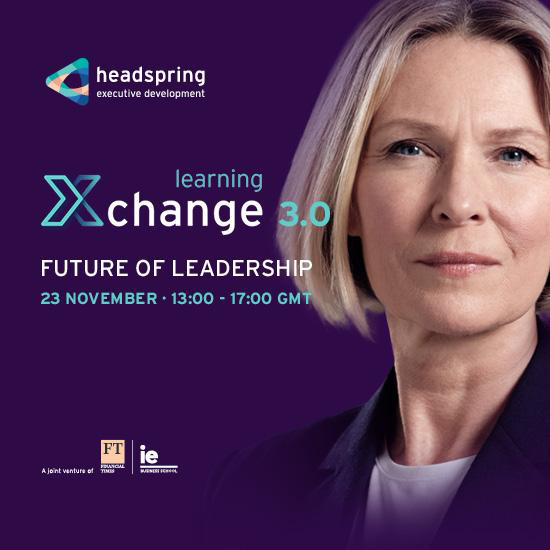
André Lacroix takes part in the Financial Times Headspring Learning Xchange summit
In November, André Lacroix was invited to share his thoughts on leadership as a panellist during the Headspring Learning Xchange summit exploring Purposeful Leadership.
Here’s how he responded to questions during discussion.
What are the skills required for future leaders?
“The opportunities inside companies for the leaders of tomorrow are immense. Companies are better run today than before, but it is my view that companies are over-managed and under-led. Why? Because 80% of the workforce is disengaged, according to Gallup. This means that every day 2.8 billion employees go the workplace without passion and excitement.
Making the global workplace a better place for more than 2.8 billion employees is the opportunity future leaders have. Companies will unleash their potential only if they operate with a highly engaged workforce in every part of the organisation. To do this, the corporate world needs good leadership.
Good leaders operate with strong values – respect, courage, passion, integrity and responsibility. They lead based on an inspirational purpose that is meaningful for their employees.
Good leaders are visionary and innovative entrepreneurs. They understand how to create growth and sustainable value for all stakeholders: employees, customers, suppliers, regulators, shareholders and the community.
Good leaders lead with both EQ and IQ, recognising that putting people at the heart of the company strategy and the day-to-day execution is the only way to deliver results these stakeholders.
Importantly good leaders recognise that sustainability is the movement of our time, and that the younger generation is right to put pressure on companies to save our planet. They might be 20% of the world population, but they are 100% of the future.”
How should leaders act in times of crisis?
“Successful companies operate with the right equilibrium between the organisation’s capability and operating complexity. When a crisis happens, a shock will impact your business and increase the operating complexity for your teams overnight.
I have been a CEO for more than 25 years. I’ve been lucky enough to work for, and with, some great companies, and in that time I’ve been able to steer them through some challenging moments. I have three pieces of advice for leaders on how to act during a crisis.
First, spend time peeling the onion to understand what is happening, contextualise the situation for the organisation and determine short-term goals to give people hope that there is light at the end of the tunnel.
Second, it is always good to reframe and prioritise by asking the organisation to focus on fewer, bigger, faster action plans. Said differently, a laser focus on the few initiatives which will have a big impact and that you can implement quickly to make a difference.
Third, I advise to lead with emotional intelligence, energise the organisation, communicate frequently, recognise progress, and celebrate successes. Sharing quick wins will create a lot of energy, have a very positive impact on the engagement of the organisation and step up your performance.”
How are you preparing your workforce for future challenges?
“At Intertek, we are very fortunate, as we operate a high-quality growth business model and help companies to operate with the highest quality, safety and sustainability standards. We are a force for good making the life of everyone better in society. Our work is mission critical for the world to operate safely and we therefore have intrinsic defensive characteristics. We operate in more than 100 countries, and of course we face challenging situations from time to time.
To make sure we are prepared for these circumstances, here is what we do:
First, we make sure we focus on both the leading and lagging indicators across all of our operations to truly understand our business. It is about understanding the real trends, being paranoid about a potential change of trajectory, and always being ahead to take corrective actions.
Second, we always communicate openly and transparently on a regular basis within the organisation. It is about making sure everyone is part of the team, that we are all on the same page, that everyone hears about good news and bad news, that there are no surprises for everyone, and that we are aligned to take actions if needs be.
Third, we always contextualise our performance within our competitive set and engage our teams on what can be done to outperform your competitors. It is about anchoring the fact that no matter what the industry does, being the best is what really matters to create a superior service for your customers and a high sense of pride for everyone in good times and bad times. Success is never a straight line. There will be ups and downs, and you have to recognise that.”
You can watch a replay of the conference here: https://lnkd.in/ekAQWPAE
#LeadershipWithSoul #PeopleAtTheHeart